⚡ Quick Answer: Why Is My AC Running But Not Cooling?
- ✓A dirty air filter is the #1 cause — free to fix in 5 minutes
- ✓A frozen evaporator coil shuts down cooling but looks like the system is working fine
- ✓Low refrigerant from a leak gets worse every day you leave the system running
- ✓A dirty outdoor condenser can cut cooling capacity by up to 40%
- ✓Oversized or undersized systems run continuously but never properly condition NoVA's humid air
- ✓Duct leaks are widespread in Fairfax's older townhomes — cool air escapes before reaching rooms
- ✓A failing compressor usually signals that system replacement is approaching
It's the most frustrating HVAC problem in Northern Virginia: your air conditioner is running — the fan is blowing, the thermostat is set, you can hear the system working — but the house just won't get comfortable. You're sweating in Fairfax in late June and something is clearly wrong.
The good news? At least three of the seven causes below can be resolved in the next 20 minutes with no tools and no professional. The bad news is that two of them — a refrigerant leak and a failing compressor — will become significantly more serious the longer the system keeps running. This guide helps you figure out which situation you're in.
NoVA's IECC climate classification placing the highest combined heating and cooling demand on residential systems
IECC Climate Zone MapWhat Causes an Air Conditioner to Run Without Actually Cooling?
When an AC runs but doesn't cool, something has interrupted the refrigeration cycle — the process of absorbing heat from indoor air and releasing it outside. The cause is almost always one of seven things: blocked airflow, a frozen coil, low refrigerant, a dirty condenser, an incorrectly sized system, duct leaks, or compressor failure.
Your AC cools through a continuous loop: refrigerant absorbs heat from your indoor air at the evaporator coil, travels to the outdoor unit where that heat is expelled, and then cycles back inside. If any link in that chain is compromised — even partially — you'll get airflow without meaningful cooling. Here are the seven causes, ranked from easiest to most urgent.
Dirty or Clogged Air Filter
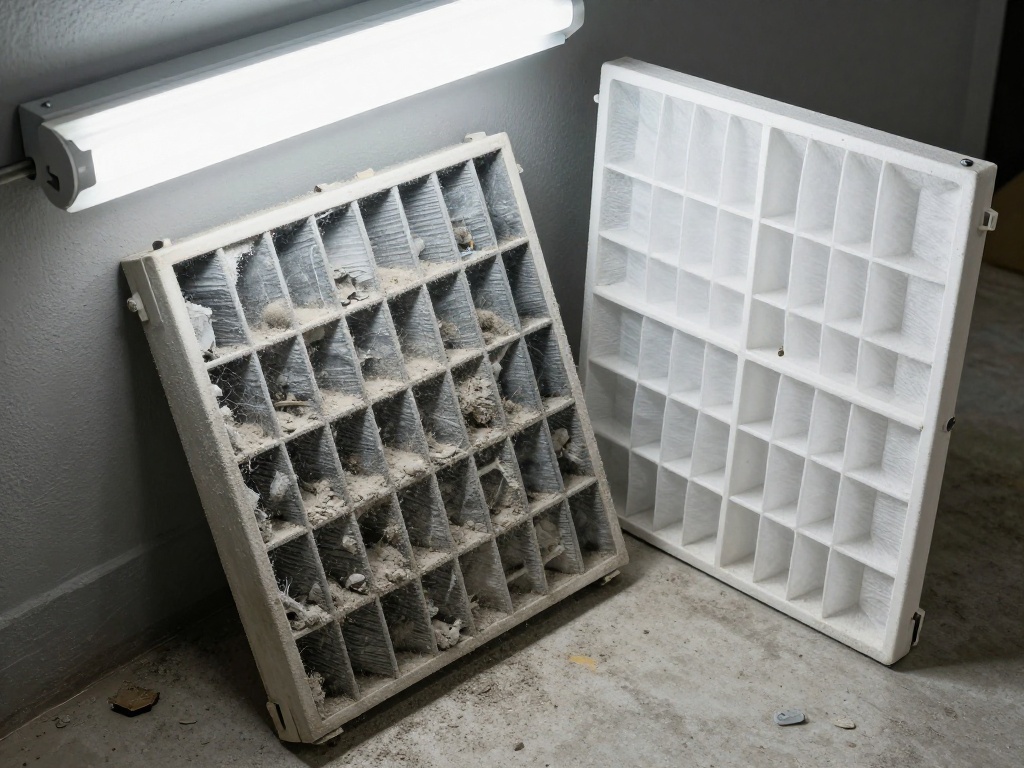
Northern Virginia's pollen season runs from February through October. If your filter hasn't been changed in the last 60–90 days, it may be so restricted that your system is essentially trying to breathe through a pillow. The evaporator coil can't absorb heat from air it can't receive.
Check: Pull the filter out. If you can't see light through it, replace it immediately with a MERV-8 to MERV-11 rated filter and give the system 30 minutes to stabilize.
Frozen Evaporator Coil
A frozen coil is counterintuitive — ice on the cooling coil means your AC is overcooling in one spot and underperforming everywhere else. The most common causes are a dirty filter, low refrigerant, or a blocked return vent. When the coil ices over, airflow essentially stops.
Check: Open the air handler and look for ice on the copper coil or refrigerant lines. If you see ice, switch the system to fan-only mode or turn it off entirely for 2–4 hours to thaw. Do NOT keep running the AC in cooling mode — you risk damaging the compressor.
Dirty Outdoor Condenser Unit
The outdoor condenser unit dumps the heat extracted from your home into the outside air. If the fins are clogged with grass clippings, cottonwood fluff, or dirt — common in Fairfax neighborhoods with mature landscaping — it can't release heat effectively. System pressure spikes and cooling capacity drops sharply.
Check: Walk outside and inspect your condenser. If the fins are visibly dirty or vegetation has grown within 2 feet of the unit, gently rinse the fins with a garden hose at low pressure, spraying from inside the fins outward. Clear the surrounding area and give the unit time to dry before retesting.
Low Refrigerant (Refrigerant Leak)
This is the most common reason pros get called in summer — and the most dangerous to ignore. Refrigerant doesn't get used up. If your system is low, it has a leak. A system running on low refrigerant absorbs less heat, the compressor strains under incorrect pressure, and your energy bills climb while comfort drops.
Signs: Warm air from vents despite a running system, ice on the refrigerant lines or coil, a hissing or bubbling sound near the unit, or a sudden spike in your Dominion Energy bill.
Under EPA Section 608, refrigerant must be handled by certified technicians. This is not a DIY repair.
Duct Leaks — Cool Air Escaping Before It Reaches You
The ENERGY STAR program estimates that the average home loses 20–30% of conditioned air through duct leaks. In a Fairfax townhome or older single-family home, your AC may be producing full cooling capacity but only delivering a fraction of it to the living space. The system runs continuously, everything appears to function — but certain rooms never cool properly.
Signs: Rooms consistently warmer than others, high energy bills relative to neighbors with comparable homes, excessive dust near vents.
Wrong System Size — Too Big or Too Small
In Northern Virginia's Climate Zone 4A, an incorrectly sized HVAC system is a persistent comfort problem that no repair will fix. An oversized system blasts cold air, satisfies the thermostat temperature quickly, and shuts off before removing enough humidity — leaving you feeling clammy even at a low setpoint. An undersized system runs non-stop and can never reach setpoint on a peak summer day.
This is especially common after homeowners add square footage, convert basements, or install new windows without having the HVAC system re-evaluated by a licensed professional.
Failing or Failed Compressor
The compressor is the heart of your AC system. A failing compressor may still appear to "run" — you'll hear the outdoor unit start — but it won't build sufficient pressure to drive the cooling cycle. Hard starts, clicking sounds, or the unit repeatedly tripping the breaker are warning signs.
At this stage, the repair-vs-replace calculation becomes important. Ask Fairfax Mechanical about currently available federal 25C tax credits and Dominion Energy rebates before committing to a compressor repair on an older system.
🔶 2026 Refrigerant Update: What Fairfax Homeowners Need to Know
If your system was installed before 2010, it likely uses R-22 (Freon), which was phased out under the EPA's ODS phaseout program and is now extremely limited in availability. Systems from 2010–2024 typically use R-410A, which is itself being phased down under the AIM Act. New systems installed in 2026 use R-454B or R-32. If your technician discovers a leak in a system using R-22, ask Fairfax Mechanical for an honest comparison before committing to a refrigerant top-off on an aging unit.
Could Duct Leaks or System Sizing Be Why My AC Won't Keep Up?
Yes — and these are two of the most under-diagnosed causes in Fairfax's housing stock. Townhomes built in the 1980s–2000s commonly have original ductwork with significant leakage. An oversized system is equally problematic: it short-cycles, removes less humidity, and leaves you feeling sticky even when the thermostat reads a comfortable temperature.
⚠ What Happens If You Keep Running a Struggling AC?
- ⚠A refrigerant leak addressed today is far less damaging than a compressor failure next month
- ⚠A frozen evaporator coil left running can bend coil fins and permanently reduce efficiency
- ⚠Running a low-refrigerant system through a NoVA summer can void manufacturer warranties
- ⚠Indoor humidity above 60% — common when AC underperforms — accelerates mold growth in ductwork and crawl spaces
- ⚠A system compensating for an unaddressed problem runs far longer than necessary, driving up your Dominion Energy bill every billing cycle
"The most expensive HVAC call we make is the one that comes two weeks after the homeowner noticed something was wrong but kept running the system. In Northern Virginia's summer heat, a minor refrigerant issue can escalate to a compressor replacement in a single billing cycle."— Fairfax Mechanical Technical Team, Fairfax, VA
How Do I Know If I Should DIY or Call an HVAC Tech in Fairfax?
If you can see the problem, it doesn't involve refrigerant, and it doesn't require electrical work — you can likely handle it yourself. Everything else warrants a call to a licensed HVAC contractor in Fairfax.
| Cause | DIY or Pro? | Urgency |
|---|---|---|
| Dirty air filter | DIY | Do it right now |
| Frozen evaporator coil | DIY to thaw; Pro to diagnose | Turn off system immediately |
| Dirty outdoor condenser | DIY (gentle rinse) | This week |
| Refrigerant leak | Pro Required (EPA law) | Urgent — worsens daily |
| Duct leaks | Pro | Schedule soon |
| Wrong system size | Pro required | Schedule — not an emergency |
| Failing compressor | Pro | Stop running the system |
Not sure which issue you're dealing with? Fairfax Mechanical offers same-day diagnostic visits across Fairfax County, Reston, Herndon, and all of Northern Virginia.
Book a DiagnosticWhy Do Northern Virginia Homes Have More AC Problems Than the National Average?
Northern Virginia's IECC Climate Zone 4A is one of the most demanding environments for HVAC systems in the country. High summer humidity, wide seasonal temperature swings, and a large stock of aging suburban housing all combine to stress systems harder and faster than in most U.S. markets.
📍 Northern Virginia HVAC Factors Unique to This Region
- Aging housing stock: A large share of Fairfax County homes were built during the 1970s–1990s suburban expansion and may have original or deteriorating ductwork
- High humidity load: NoVA's humidity requires an AC that runs long enough to dehumidify — oversized systems that short-cycle leave homes feeling muggy even at correct temperatures
- Cottonwood and pollen season: From April through June, airborne debris clogs condenser fins at an accelerated rate — learn more at AirNow.gov
- Dominion Energy peak hours: On high-demand summer days (typically 4–9 PM), borderline compressors can struggle to start reliably
- NoVA labor market: HVAC labor in Fairfax runs above Virginia's state average — another reason to address issues early before they escalate
"In mixed-humid climates like Northern Virginia, the AC's job isn't just to lower temperature — it's to lower dew point. A system that's only cooling temperature but not removing humidity will feel far hotter than the thermostat says. Proper sizing and airflow are critical in this specific market."— ACCA Industry Sizing Guidelines
Are There Rebates If My AC Needs to Be Replaced in Fairfax in 2026?
Yes. Federal tax credits, Dominion Energy rebates, and continued Inflation Reduction Act incentives can meaningfully reduce your out-of-pocket cost on qualifying replacement systems in 2026.
| Program | Incentive | Learn More |
|---|---|---|
| Federal 25C Tax Credit | Up to $600 (AC) / Up to $2,000 (heat pump) | IRS.gov |
| Dominion Energy Smart Home Rebates | Rebates for qualifying heat pump installs & tune-ups | dominionenergy.com |
| Dominion Smart Thermostat Rebate | Instant rebate on connected thermostats | dominionenergy.com |
| Virginia SAVES Green Community Program | Low-interest financing for energy efficiency upgrades | veda.org |
Frequently Asked Questions: AC Running But Not Cooling
AC Running But Still Not Cooling? We'll Figure It Out — Today.
Fairfax Mechanical serves all of Fairfax County, Reston, Herndon, McLean, Vienna, and surrounding Northern Virginia communities. Same-day diagnostic appointments available. Honest assessments, upfront answers, no upsells.
This article is for informational purposes only. Always consult a licensed HVAC professional before performing any work beyond filter changes and basic cleaning.